
Buyer enablement: the free tools that get B2B deals approved (plus an HR software scorecard to steal).
I see this with clients all the time.
The demo goes well. The HR leader is engaged, asks good questions and wants to see pricing. “Let me take this to the team.”
Then nothing. Two weeks. Four weeks. A polite “we’re still evaluating.”
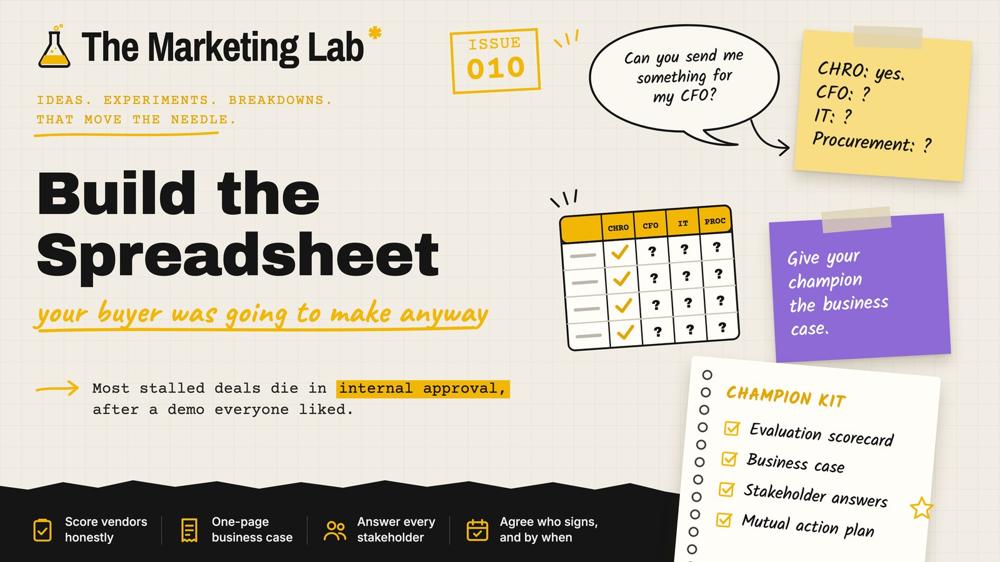
The demo did its job. The champion’s interest just didn’t turn into a tick in every box across the buying committee. The CHRO was convinced. The CFO, IT and procurement were never in the room, and nobody gave them a reason to say yes.
So somewhere, your champion is building a spreadsheet at 10pm to explain your product to people who have never seen it. Your competitor’s numbers are in the next column.
Why deals stall after a good demo
Gartner’s research on B2B buying explains most of it:
- Buyers spend only 17% of their buying time meeting potential suppliers. When they’re comparing several vendors, your share is closer to 5% or 6%.
- They spend 22% of their time in meetings with their own buying group, where you aren’t invited.
- A complex B2B purchase involves 6 to 10 decision-makers.
Most of the selling happens in meetings you’ll never attend, led by someone who isn’t on your payroll. At enterprise level, the CFO, IT and procurement will all have their hands in it.
Your champion can’t win those meetings on enthusiasm. They need material.
The tactic: build the buyer’s spreadsheet
Gartner calls this buyer enablement: giving buyers the information and tools they need to complete the buying job themselves. Their research found that buyers who got this kind of help from a supplier were 2.8 times more likely to find the purchase easy and 3 times more likely to buy a bigger deal with less regret. (These figures come from Gartner’s 2018 and 2019 buyer research. They’re older, but they’re still the standard reference.)
In practice, your champion needs four things:
- An evaluation scorecard. The criteria, how much each one matters and how to score each vendor.
- A one-page business case. The problem, what it costs to do nothing, the expected impact, the cost, the risks and the timeline.
- Answers for every stakeholder. What the CFO, IT and procurement will ask, answered before they ask it.
- A mutual action plan. Who needs to sign what, and by when.
If you don’t give them these, they’ll make their own. You won’t like how yours looks in it.
Who’s already doing this
Some of the biggest HR tech vendors give the evaluation tools away.
Lattice offers a free HRIS evaluation template with a rating system for comparing platforms, plus an HRIS RFP template. Rippling publishes its own HRIS RFP template covering payroll, integrations and API requirements.
On the sales side, tools like Accord and Pitch offer templates built for exactly this job: arming your champion with a business case and an action plan.
Notice what Lattice and Rippling are doing. Their templates are useful to anyone choosing an HRIS, including people evaluating competitors. That’s the point. Every HR leader who searches “HRIS RFP template” finds them first, and starts their evaluation on their criteria.
The smart move is to do both: publish a category template that anyone can use, and give your champions a personalised version for every deal.
How to do it this week
- Ask sales for the last five deals that stalled after the demo. For each one, find out which question it got stuck on, and who asked it.
- List everyone who signs off, and what each person needs to see before they say yes.
- Build a scorecard that’s honest. Include the criteria where you aren’t the strongest. A scorecard rigged in your favour gets spotted and binned, and it takes your credibility with it.
- Turn the answers into a one-page business case with blanks your champion fills in with their own numbers.
- Publish one version, and send the editable version after every demo. Then track the time from demo to decision. That’s the number this should move.
The HR tech twist
HR software decisions in Asia pull in more people than most vendors plan for. At enterprise level, finance, IT and procurement are involved alongside HR, and regional HQ often wants a say too.
Build their questions in from the start:
- IT and security will ask where the data is stored, how it meets PDPA and the privacy laws in each country, and how it connects to existing systems.
- Finance will want the cost over three years, including implementation and internal time, and a conservative payback date.
- Procurement will want to see that you were compared fairly against alternatives.
- Regional HQ will want to know it fits the global HR stack.
If your champion walks into those meetings with the answers already written, you’ve done more for the deal than another follow-up email ever will.
Steal this: the HR Software Evaluation Scorecard 📊
I built a free scorecard you can copy and use, whether you’re an HR leader choosing software or a vendor helping a champion get a deal approved.
Make your own copy of the HR Software Evaluation Scorecard (Google Sheets)
It has three tabs:
- Scorecard. Eight weighted criteria, with the score out of 100 calculated for up to three vendors: fit to requirements (20%), integrations (15%), data security and privacy (15%), multi-country compliance (10%), implementation (10%), total cost over three years (15%), adoption (10%) and vendor viability and local support (5%). Change the weights to suit your company.
- Business case. A one-page template with prompts for every section a CFO will look for.
- Stakeholder map. CHRO, CFO, IT, procurement, HR operations, managers and regional HQ: what each cares about, the questions they’ll ask and the proof they need.
No email required.
Lab Notes
- Keep it honest. A scorecard only you can win reads like a brochure, and buyers can tell.
- Keep the business case to one page. Nobody on the approval chain reads page two.
- Update it every time you lose a deal. The question that killed the deal belongs in the stakeholder map.
- Ask one question after every demo: “Who else needs to say yes, and what will they ask you?” Then help your champion answer it.