
I have yet to meet a B2B marketer who proudly tells me, “Our case studies are our biggest source of leads.”
Most companies have them. Very few buyers read them. Even fewer finish them.
The irony? Case studies should be one of your most persuasive sales assets. Instead, they’ve become glorified press releases tucked away under a lonely “Customers” menu.
The problem isn’t that buyers don’t like case studies. The problem is that we’ve been writing them for ourselves instead of the people we’re trying to convince.
What buyers are actually looking for
Imagine you’ve shortlisted three HR platforms. All three claim to reduce manual work. All three have AI. All three promise better outcomes.
Now you click into a customer story. You aren’t wondering whether the vendor is innovative. You’re asking yourself:
- Is this company similar to mine?
- Did they have the same problem?
- How difficult was implementation?
- What actually changed?
- Would I survive this project?
If your case study doesn’t answer those questions within two minutes, you’ve probably lost them.
Mistake #1: Starting with the company instead of the problem
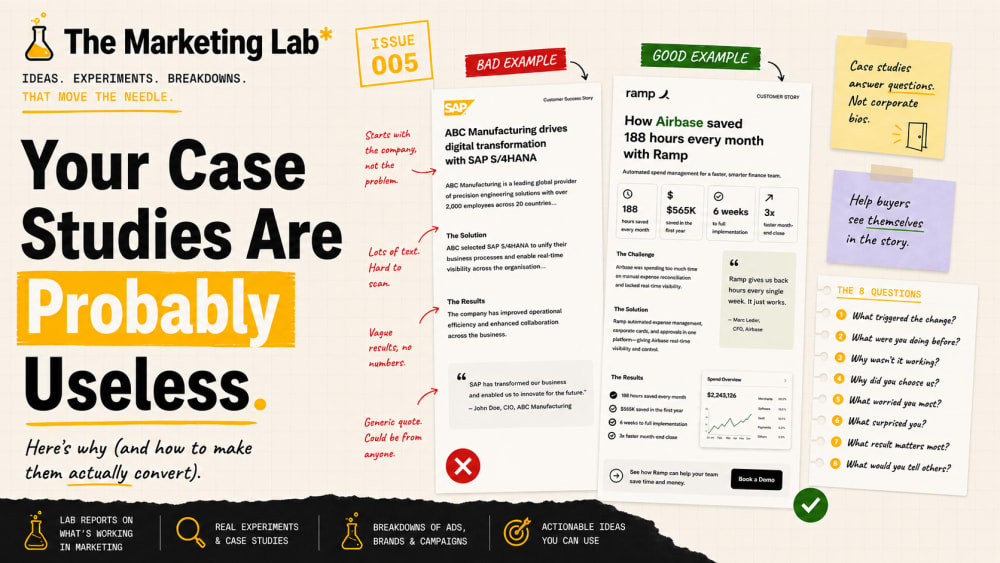
Most case studies begin like this: “ABC Manufacturing is a leading provider of precision engineering solutions with over 2,000 employees across Asia…”
Nobody cares. Buyers don’t identify with company profiles. They identify with problems.
A much stronger opening would be: “Every payroll run took three days. HR dreaded month-end because correcting mistakes often meant another weekend in the office.”
Now I know exactly why I should keep reading. Write about the pain before the company.
Mistake #2: Turning results into marketing fluff
One of my biggest pet peeves. “We improved productivity.” “We enhanced employee experience.” “We increased efficiency.”
Compared to what? How much? How long?
If you have numbers, use them. Instead of “improved onboarding,” try “reduced onboarding from 14 days to 6.” Instead of “better hiring decisions,” try “cut interview-to-offer time by 38%.”
Specificity builds credibility. Generalisations sound like marketing.
Mistake #3: Pretending implementation was magical
Most case studies follow the same structure. Problem, bought software, amazing results. Somewhere in the middle, apparently, magic happened.
But implementation is exactly what buyers worry about. They want to know: how long did rollout take? Who was involved? What resistance did you face? What surprised you?
The messy parts are often the most convincing. Because that’s where trust is built.
Mistake #4: Writing quotes nobody would ever say
Every B2B marketer has seen quotes like this: “The platform has transformed our organisation and revolutionised the way we work.”
Has anyone ever spoken like that?
Real customers sound different. They say things like, “Honestly, I thought implementation would be painful.” Or, “Finance wasn’t convinced at first.” Or, “The biggest surprise was how quickly managers adopted it.”
Those sound human. Human is believable.
Mistake #5: Making buyers work too hard
Most case studies look like essays. Huge blocks of text. Tiny screenshots. One photo of two executives shaking hands.
Buyers don’t read websites. They scan. Help them.
Imagine your case study looked like this instead:
- The company: 500 employees, manufacturing, Singapore
- The challenge: Payroll took three days every month
- Why they chose us: Integrated with existing HRMS
- Implementation: 6 weeks
- Results: 43% faster payroll processing
- Favourite feature: Automated approval workflow
I can understand that in under a minute. That’s exactly the point.
Design your case study like a buyer reads
Most companies design case studies like whitepapers. Buyers don’t consume them that way. Think of your customer story as a landing page instead.
Break it up. Use headings. Highlight numbers. Show screenshots. Use pull quotes. Add timelines. Make it impossible not to skim.
The eight questions every customer interview should answer
Most customer interviews begin with “tell us about your company.” Skip that. Instead, ask these.
- What happened that made you realise something had to change? This gives you the opening.
- What were you doing before? Now readers understand the context.
- Why wasn’t that working? Here come the pain points.
- Why did you choose us instead of the alternatives? Probably the most important question. Your customers explain your differentiation better than your marketing team ever will.
- What worried you before implementation? These are your future buyers’ objections. Address them.
- What surprised you after going live? This usually produces the most authentic answers.
- What’s the one result you’re proudest of? Not ten metrics. One. Make it memorable.
- If another company like yours asked whether they should buy this, what would you tell them? This almost always becomes your best quote.
One more thing
Most companies hide their case studies behind a navigation menu. Then wonder why nobody reads them.
Your best customer stories should appear exactly where buyers hesitate. On pricing pages. On product pages. On comparison pages. Even next to your “Book a Demo” button.
Because that’s when buyers are asking themselves, “Has this actually worked for someone like me?” Don’t make them go looking for the answer. Put it in front of them.
Final thought
The biggest mistake companies make is thinking they’re writing customer success stories. They’re not. They’re writing buying stories.
Your future customers don’t care that your existing customer succeeded. They care whether they will.
The moment your case study helps them imagine themselves in the story, it stops being content. It becomes one of your best salespeople.