
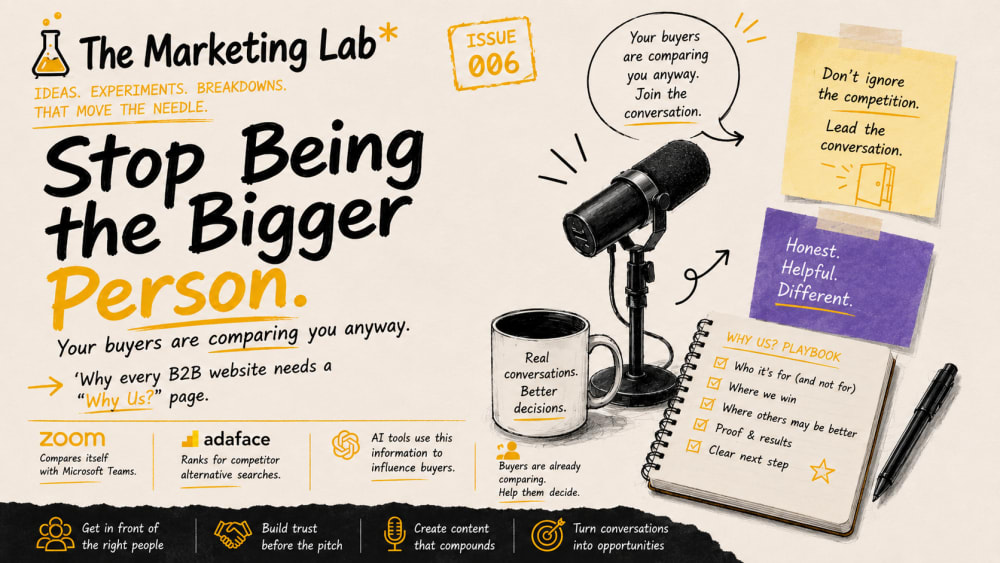
One piece of marketing advice refuses to die: “Never talk about your competitors.”
The logic is simple. Don’t give them free publicity. Take the high road. Focus on your own strengths.
It sounds sensible. Until you think about how buyers actually buy. Because nobody evaluating HR software is looking at one vendor. They’re looking at five. And while you’re pretending competitors don’t exist, your buyers are actively comparing you against them.
The only question is: who gets to shape that comparison?
Buyers don’t buy in isolation
Let’s say you’re evaluating a CRM. You’re probably asking questions like:
- HubSpot or Salesforce?
- Zoom or Microsoft Teams?
- Workday or SAP?
- Greenhouse or Lever?
Comparison isn’t a sign someone is leaving your buying journey. Comparison is the buying journey. If your website doesn’t help buyers compare, they’ll find someone else’s that does.
The middle of the funnel is where deals are won
Most marketers obsess over top of funnel, or bottom of funnel. Very few invest properly in the middle. That’s where buyers ask, “Okay… but why you?”
Not “what do you do?” Not “how much?” But “why are you different?”
That’s where comparison pages belong.
Example: Zoom
Zoom doesn’t pretend Microsoft Teams doesn’t exist. They built an entire comparison page. Why? Because they know buyers are already searching “Zoom vs Teams,” “Teams alternatives,” “which is better?” The comparison is happening whether Zoom participates or not. Zoom chose to join the conversation. That’s smart marketing.
Example: Adaface
Adaface goes one step further. Instead of a single comparison page, they built an entire library. HackerRank alternatives. Codility alternatives. TestGorilla alternatives.
Notice what they’re doing. They’re not writing SEO content. They’re creating buyer enablement content. Every page answers a real buying question. That also ranks in search. And increasingly, gets cited by AI.
AI changes everything
This is where I think most marketers haven’t caught up. Five years ago someone searched “best HR analytics platform.” Today they ask ChatGPT, “Compare Visier, Crunchr and Workday.” Or, “What’s a good alternative to Greenhouse?”
AI doesn’t have opinions. It summarises available information. If you’ve never explained who you’re for, who you’re not for, and how you’re different, someone else will. Or worse, AI will infer it from third-party websites.
“But aren’t we giving free publicity to competitors?”
Probably the biggest objection. I’d argue the opposite. Mentioning competitors doesn’t create awareness. Your buyer already knows they exist. You’re not introducing them. You’re helping buyers make sense of the market.
Think of it this way. If someone asks, “Should I buy a BMW or a Mercedes?” ignoring Mercedes doesn’t make the comparison disappear. It just means someone else gets to answer the question.
The secret is honesty
Here’s where most comparison pages fail. They’re obviously biased. Every feature is a green tick. Every competitor gets a red cross. Nobody believes that.
A better approach: be honest. For example, “If you’re a 20-person startup, Competitor X may actually be the better choice.” That sounds risky. It’s actually credibility. Because when you later explain where you do win, people believe you.
What every “why us?” page should include
Not marketing fluff. Actual buying information.
- Who is your ideal customer?
- Who isn’t?
- When should someone choose a competitor?
- Where do you genuinely outperform?
- Where are you weaker?
- Pricing philosophy.
- Migration effort.
- Common misconceptions.
- Customer stories.
- FAQs buyers ask sales.
Your sales team answers these every week. Your website should too.
The bigger picture
The purpose of a comparison page isn’t to attack competitors. It’s to reduce uncertainty. Marketing is simply helping buyers make better decisions.
If your website can answer “why should I choose you?” before a salesperson ever gets involved, you’ve shortened the sales cycle. You’ve built trust. And you’ve made AI’s job easier too.
Your buyers are already comparing you. The only question is whether they’re doing it on your website, or someone else’s.