
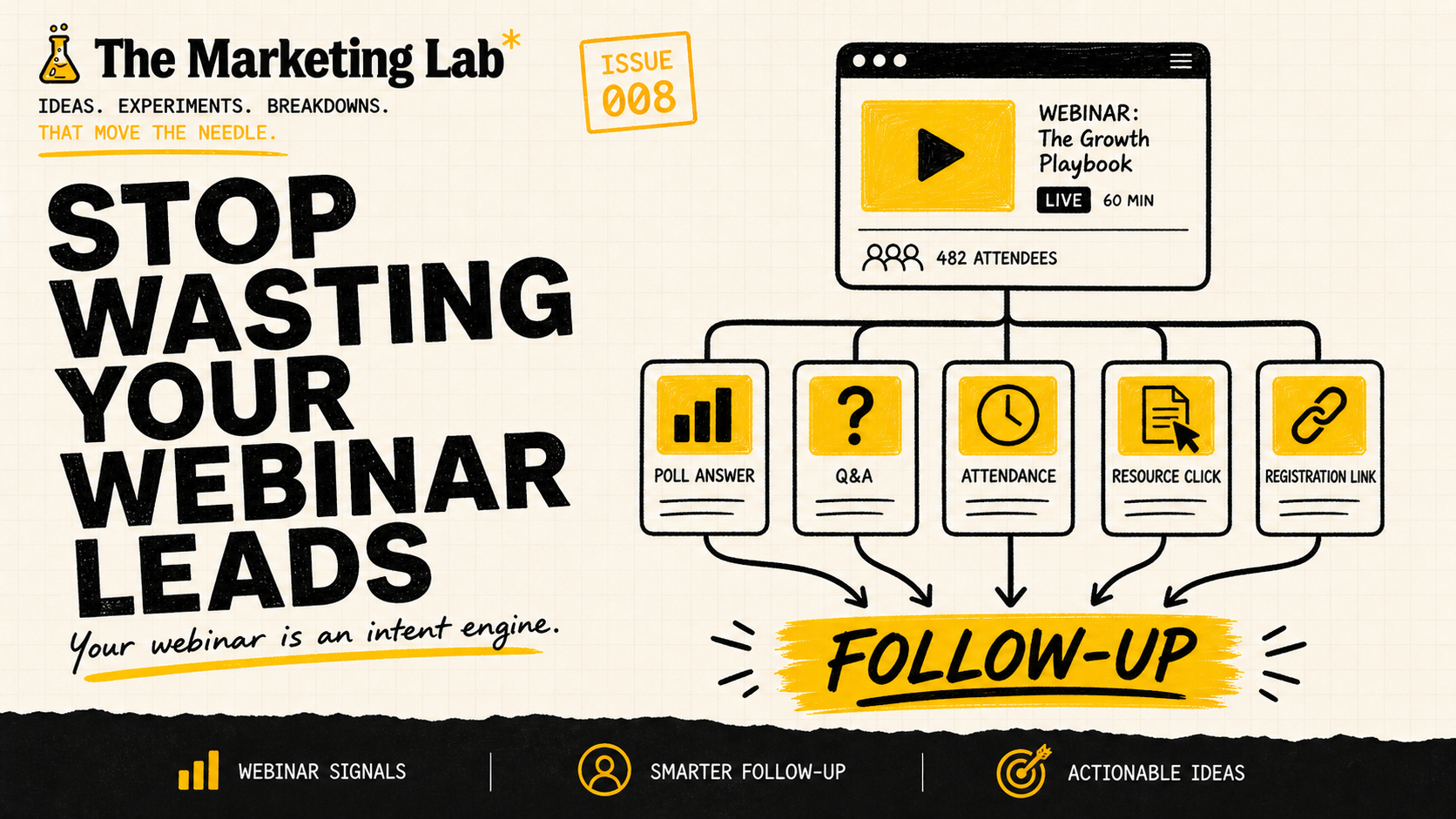
Your attendees just spent an hour telling you what they care about. Why are you sending all of them the same email?
Here is how most B2B webinars work.
Spend weeks finding a topic. Find speakers. Build the landing page. Run LinkedIn ads. Email the database. Chase speakers for their slides. Get 200 registrations.
Eighty people show up.
They answer polls. They ask questions. Some stay for the entire hour. Some leave after seven minutes.
Then the webinar ends—and Marketing sends everyone:
Thanks for attending. Here’s the recording.
Including, occasionally, the people who did not attend.
What a waste.
Because during that hour, your audience has quietly told you an enormous amount: what problems they have, what they want to learn, how engaged they were, and sometimes how close they are to buying.
The problem is not collecting the data. It is what we do with it afterwards.
Here are eight things I would do differently.
Note on the visuals: the UI in this article is an illustrative reconstruction of current webinar workflows, not a literal Zoom screenshot. Exact features and menus vary by product and licence.
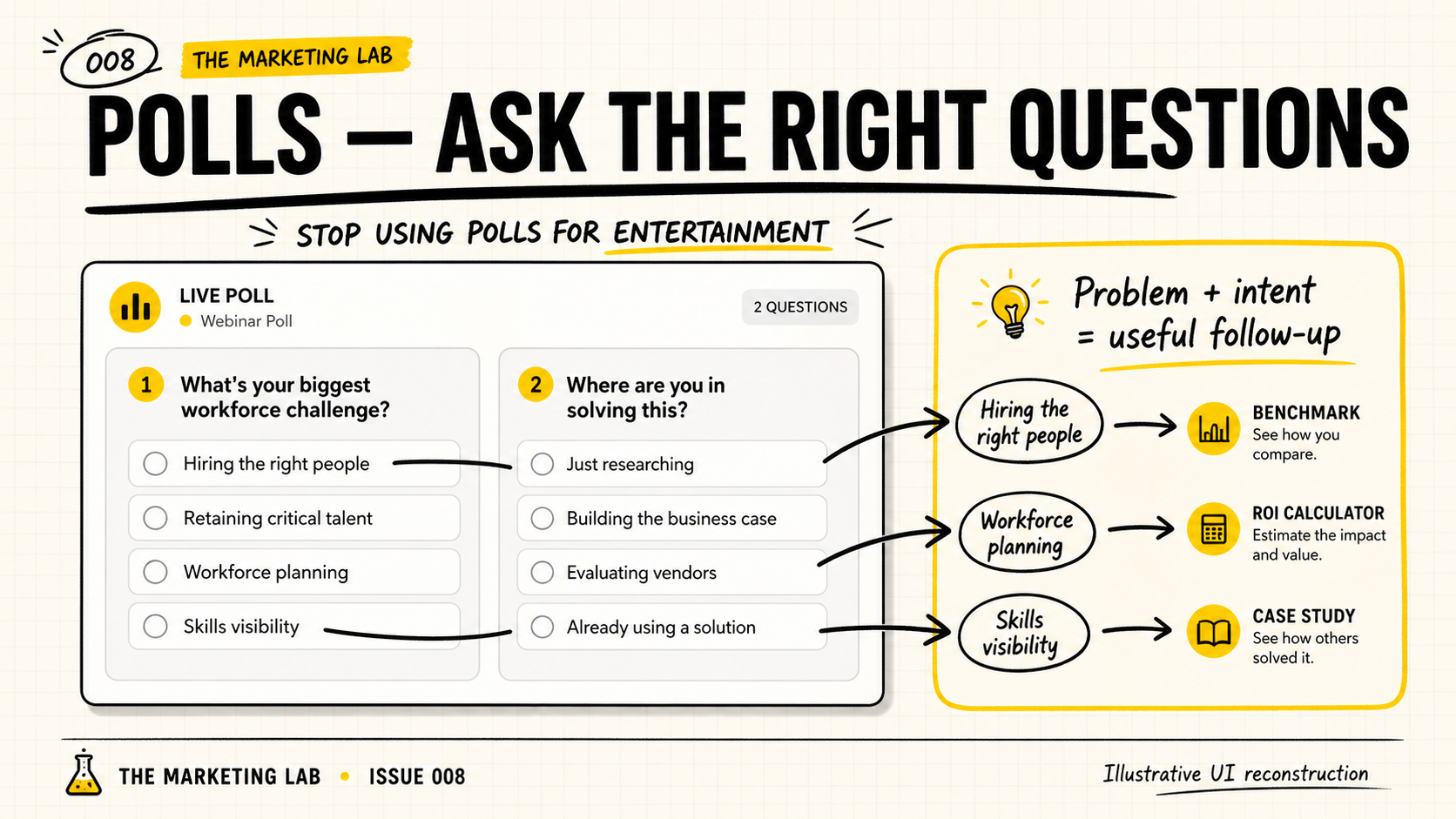
1. Stop using polls for entertainment
We have all sat through this webinar poll:
How useful are you finding today’s session?
Okay. And what are you going to do with that information?
Instead, use polls to find out what someone needs next.
Say I am running a webinar for an HR-tech company. I would ask:
What’s your biggest workforce challenge right now?
- Hiring the right people
- Retaining critical talent
- Workforce planning
- Skills visibility
Then later:
Where are you currently in solving this?
- Just researching
- Building the business case
- Evaluating vendors
- Already using a solution
Those two questions give you something much more useful than “87% found the webinar useful.” They give you problem + intent.
Someone who answers Hiring + Just researching might get your latest hiring benchmark. Someone who answers Workforce planning + Building the business case gets the ROI calculator. Someone who answers Skills visibility + Evaluating vendors gets the relevant customer case study.
Same webinar. Completely different follow-up.
2. Your Q&A is an accidental intent form
Imagine three people attend the same webinar.
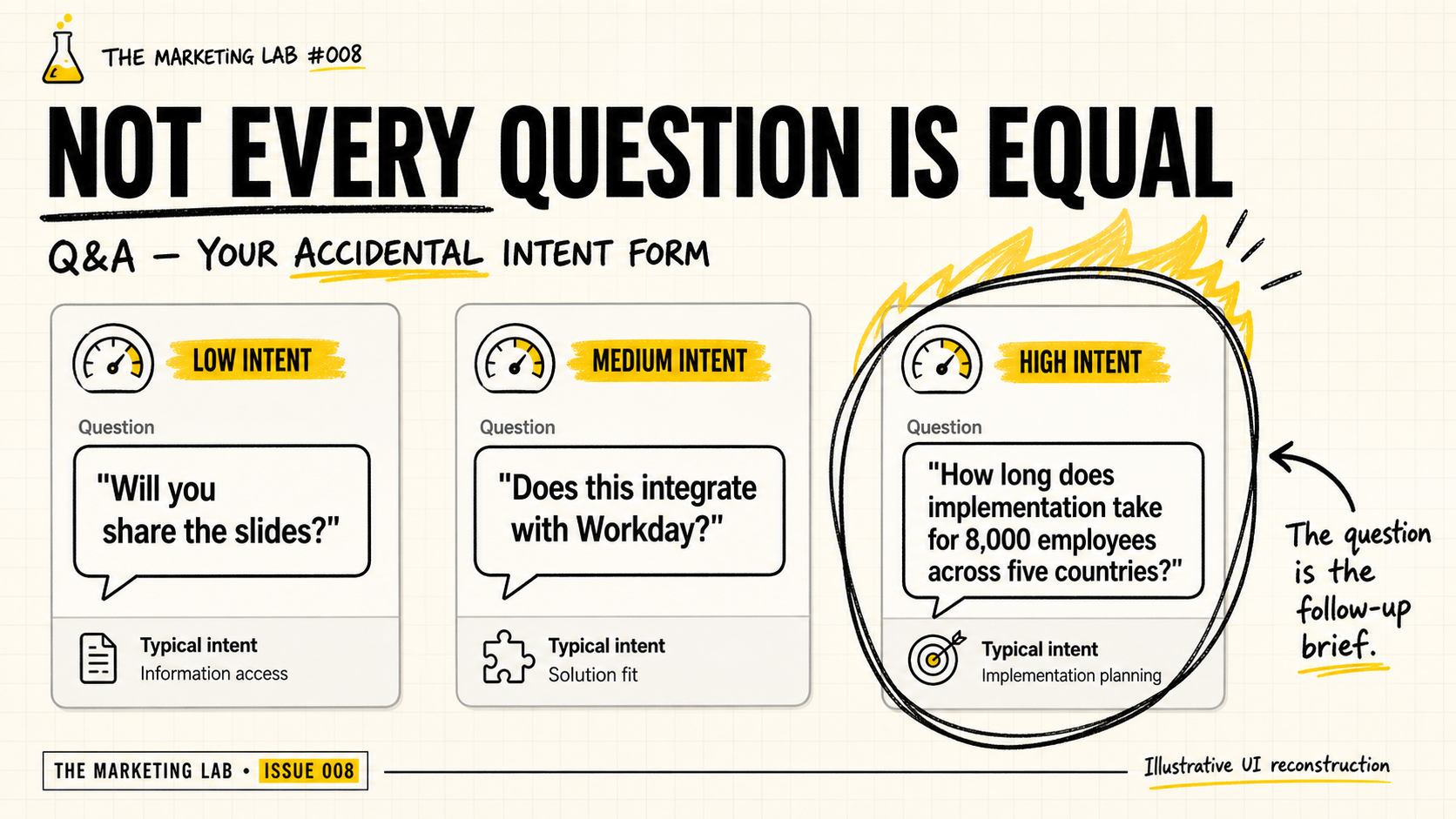
Sarah asks: “Will you be sharing the slides?”
James asks: “Does this integrate with Workday?”
Michelle asks: “How long does implementation normally take for 8,000 employees across five countries?”
Who would you call tomorrow?
Exactly.
Yet all three may land in the CRM as: Webinar attended ✓.
Michelle has practically written the follow-up email for you. Do not send her a generic “Thanks for attending—would you like a demo?” Send something like:
You asked about multi-country implementation for an 8,000-person organisation. We have a customer example that is quite close to your situation. Thought you might find it useful.
That is no longer a random sales follow-up. She gave you the reason to contact her.
3. Start collecting intent before the webinar even begins
Your registration form does not need to be an interrogation.
Company. Job title. Company size. Phone. Country. Industry. How did you hear about us? Mother’s maiden name.
Okay, I made the last one up.
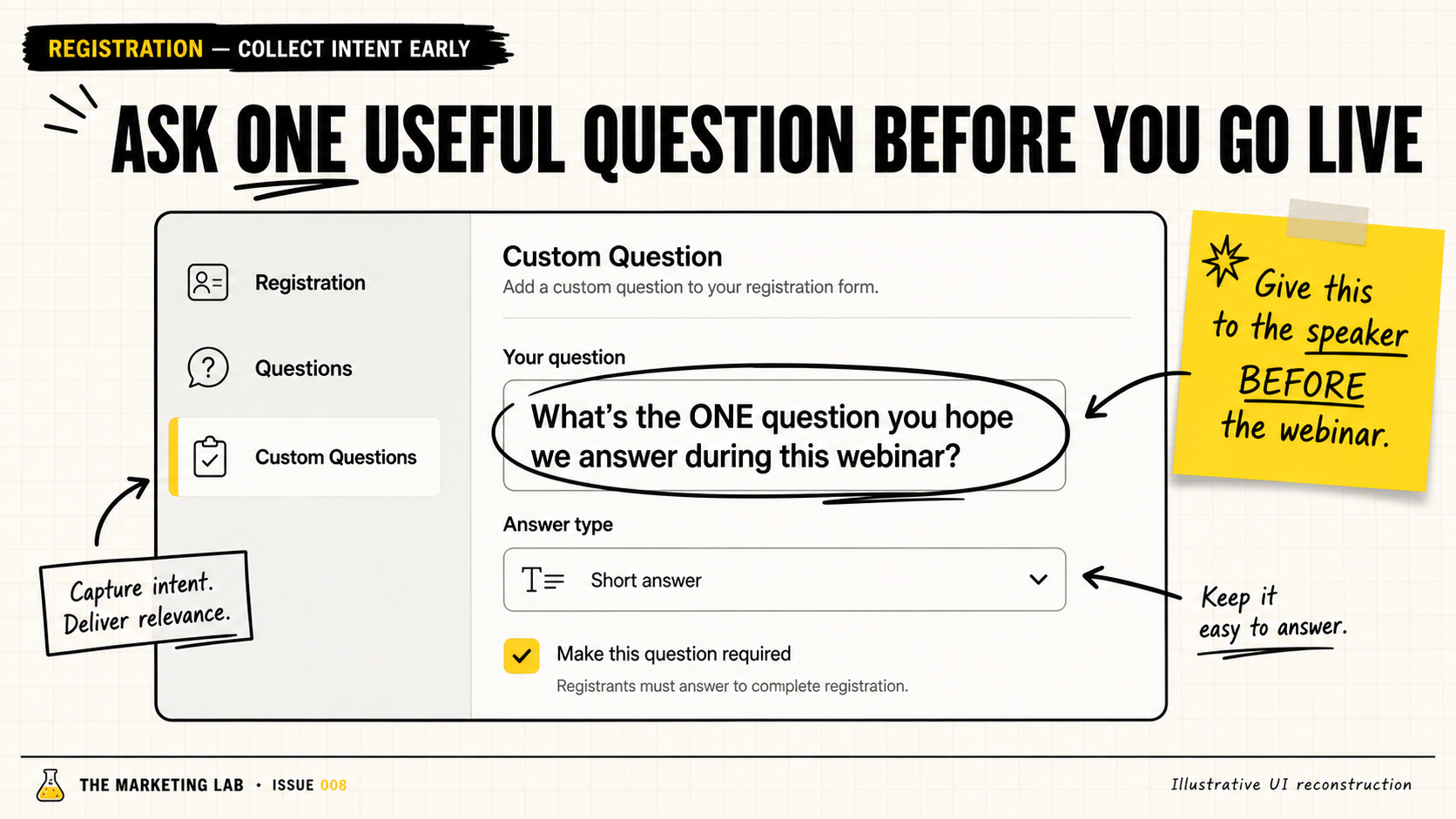
Instead of asking ten questions Marketing Ops wants, ask at least one question the speaker wants:
What’s the ONE question you hope we answer during this webinar?
You have now achieved three useful things before going live:
- You know what the audience wants.
- Your speaker can adjust the presentation.
- You have individual intent data before the session begins.
Send the speaker a one-page summary before the webinar: 47% asked about X. 31% asked about Y. Three enterprise accounts specifically mentioned Z. It is much better preparation than blindly presenting the deck.
4. Score behaviour, not attendance
Consider three people.
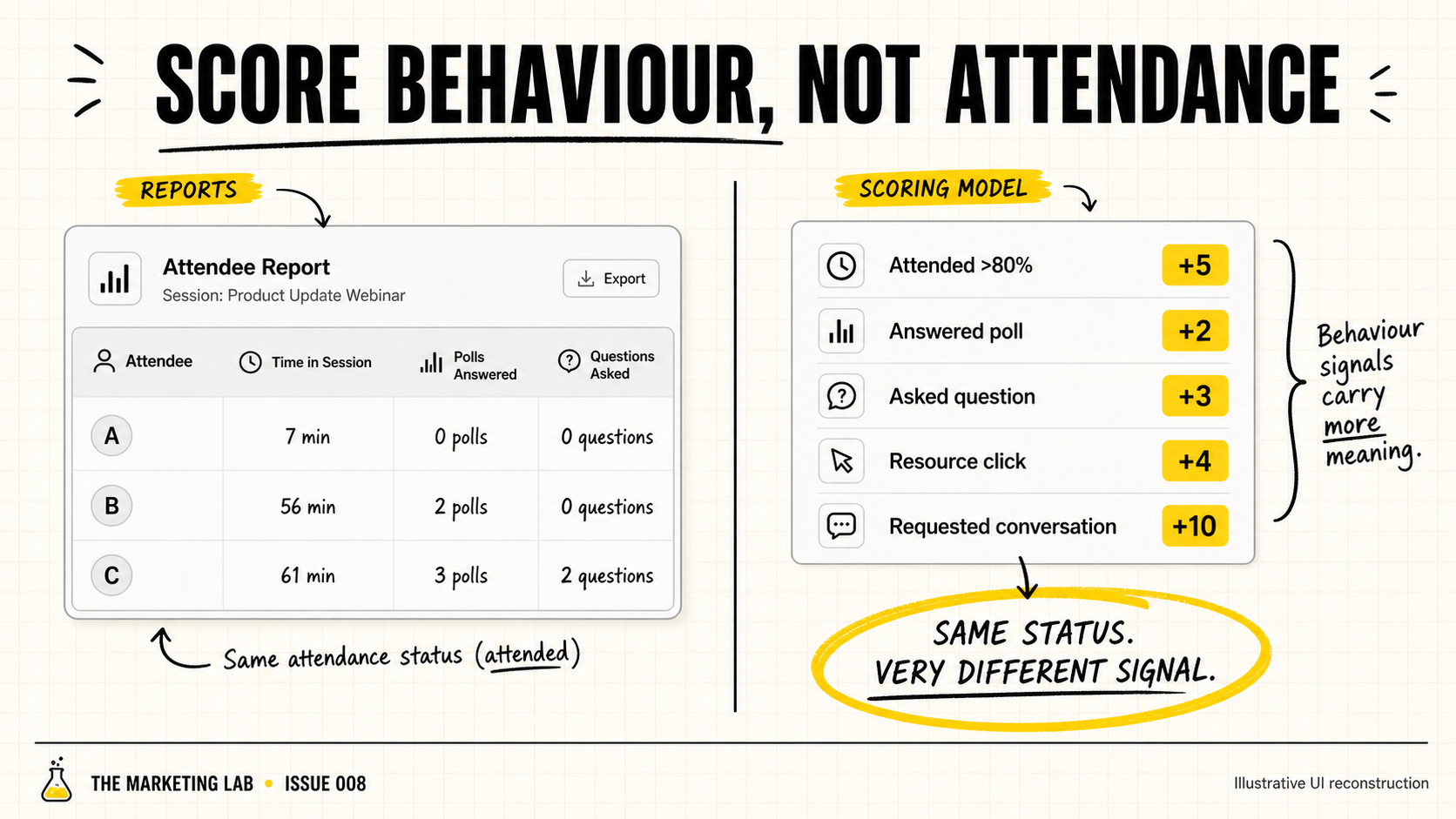
| Person | Time in session | Polls | Questions |
|---|---|---|---|
| A | 7 min | 0 | 0 |
| B | 56 min | 2 | 0 |
| C | 61 min | 3 | 2 |
Your CRM may still call all three “webinar attendees.” That throws away useful information.
Create an engagement score instead. The precise numbers are not sacred; the principle is.
| Behaviour | Example score |
|---|---|
| Registered | +1 |
| Attended more than 50% | +3 |
| Attended more than 80% | +5 |
| Answered a poll | +2 |
| Asked a question | +3 |
| Clicked a relevant resource | +4 |
| Requested a conversation | +10 |
Someone who watched for an hour, answered three polls and asked about implementation deserves a different next action from someone who opened Zoom while making lunch and disappeared seven minutes later.
5. Drop the right resource at the right moment
Do not wait three days and bury seven links in a follow-up email.
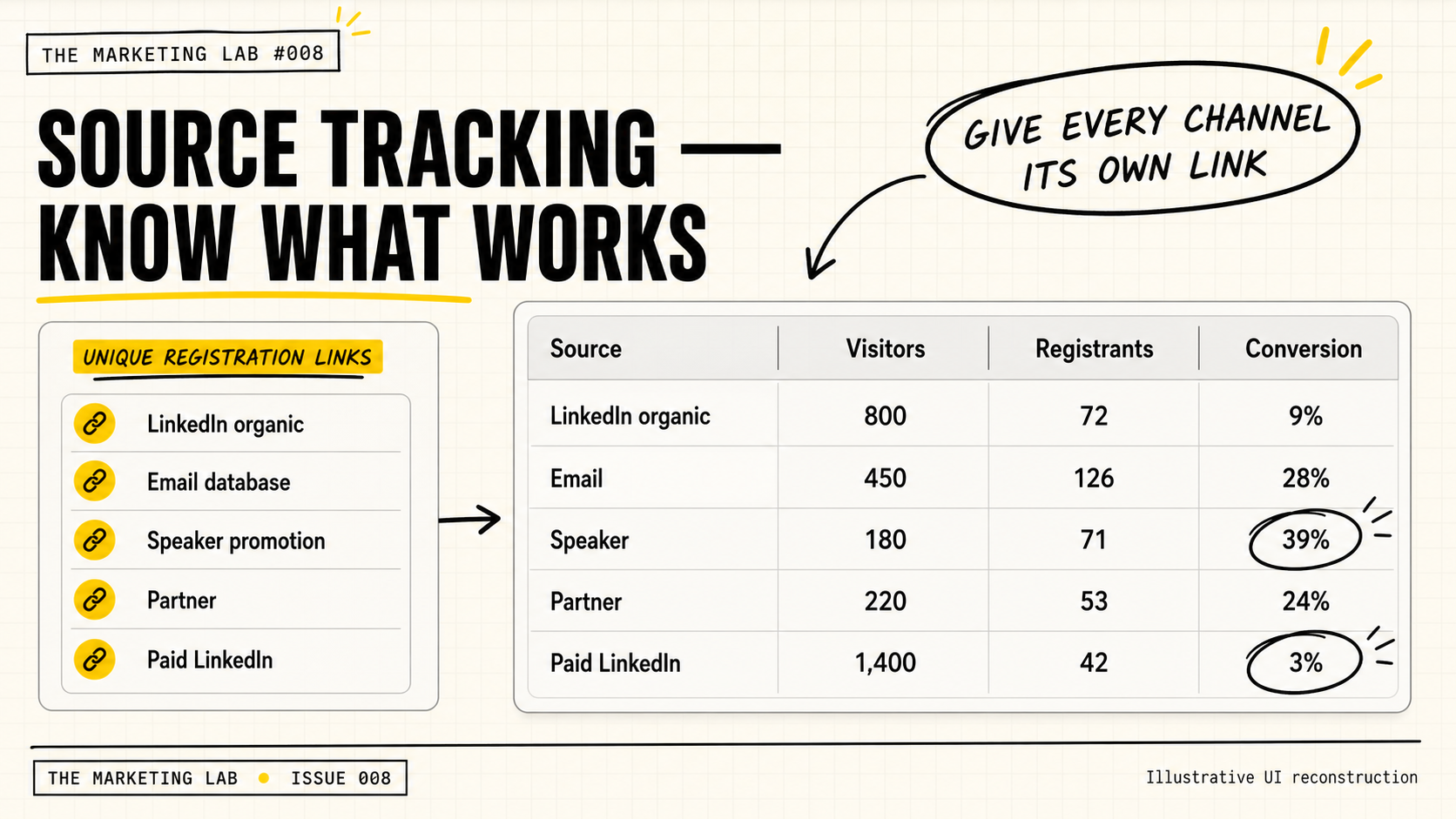
When the speaker starts talking about ROI, launch the ROI calculator. When the customer starts discussing implementation, launch the implementation guide. When someone mentions a result, launch the customer case study. When integrations come up, launch the integration overview.
The timing matters. Interest is highest while people are hearing about the problem.
And what someone clicks tells you something. A person who clicks the ROI calculator and implementation guide is demonstrating a much more useful signal than an open on a generic recording email.
6. Build five follow-up tracks, not one
This is where all the previous data becomes useful.
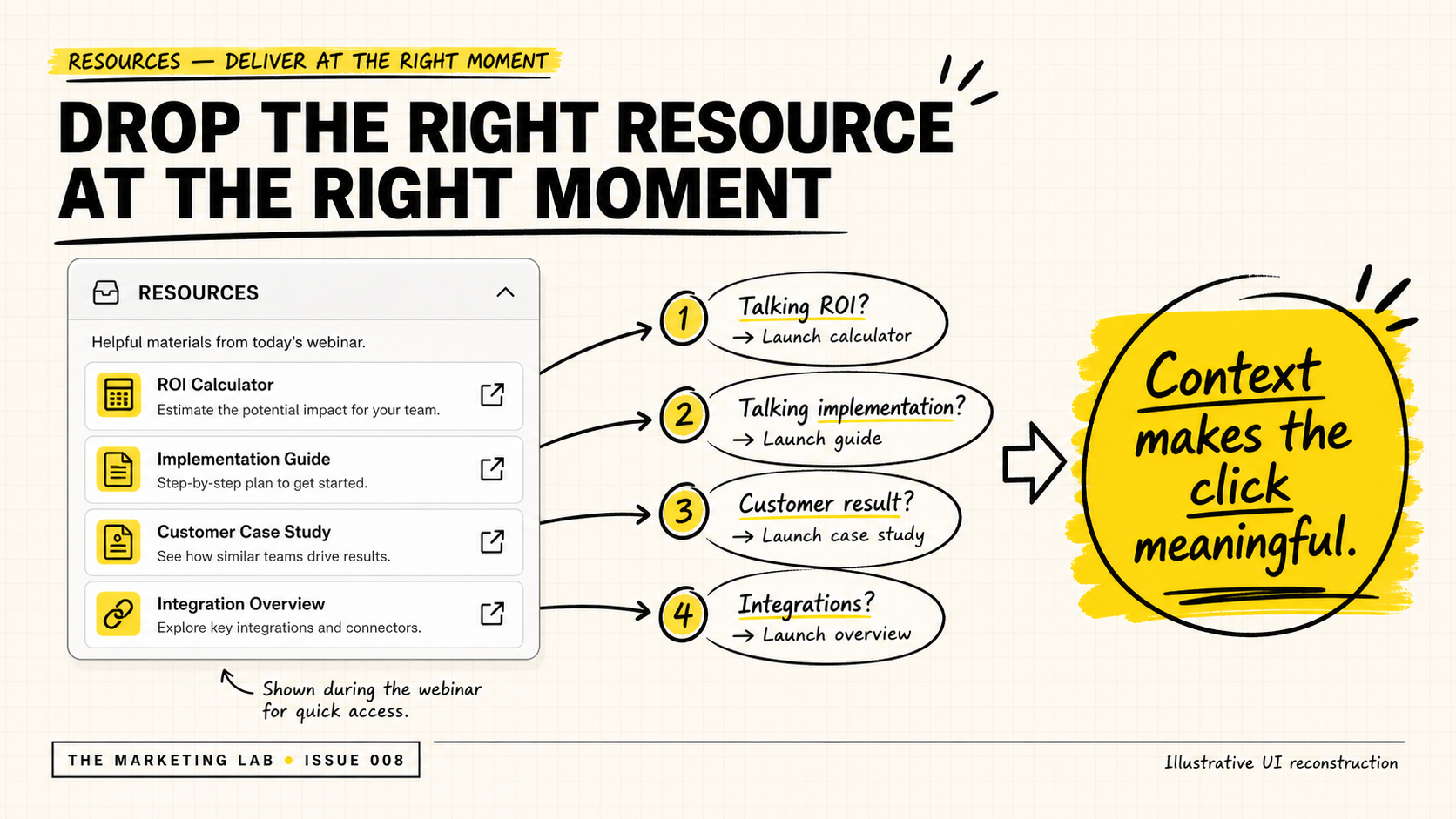
At a bare minimum, split attendees from no-shows. But that is only segmentation level one. I would create five journeys:
No show → Recording + three key takeaways.
Low engagement → Recording + concise summary.
Engaged → Poll-specific content.
High intent → Personal follow-up + relevant proof.
Customer → Education, advocacy or expansion content—not a prospect nurture.
One webinar does not need one follow-up. It needs the next useful thing for each person.
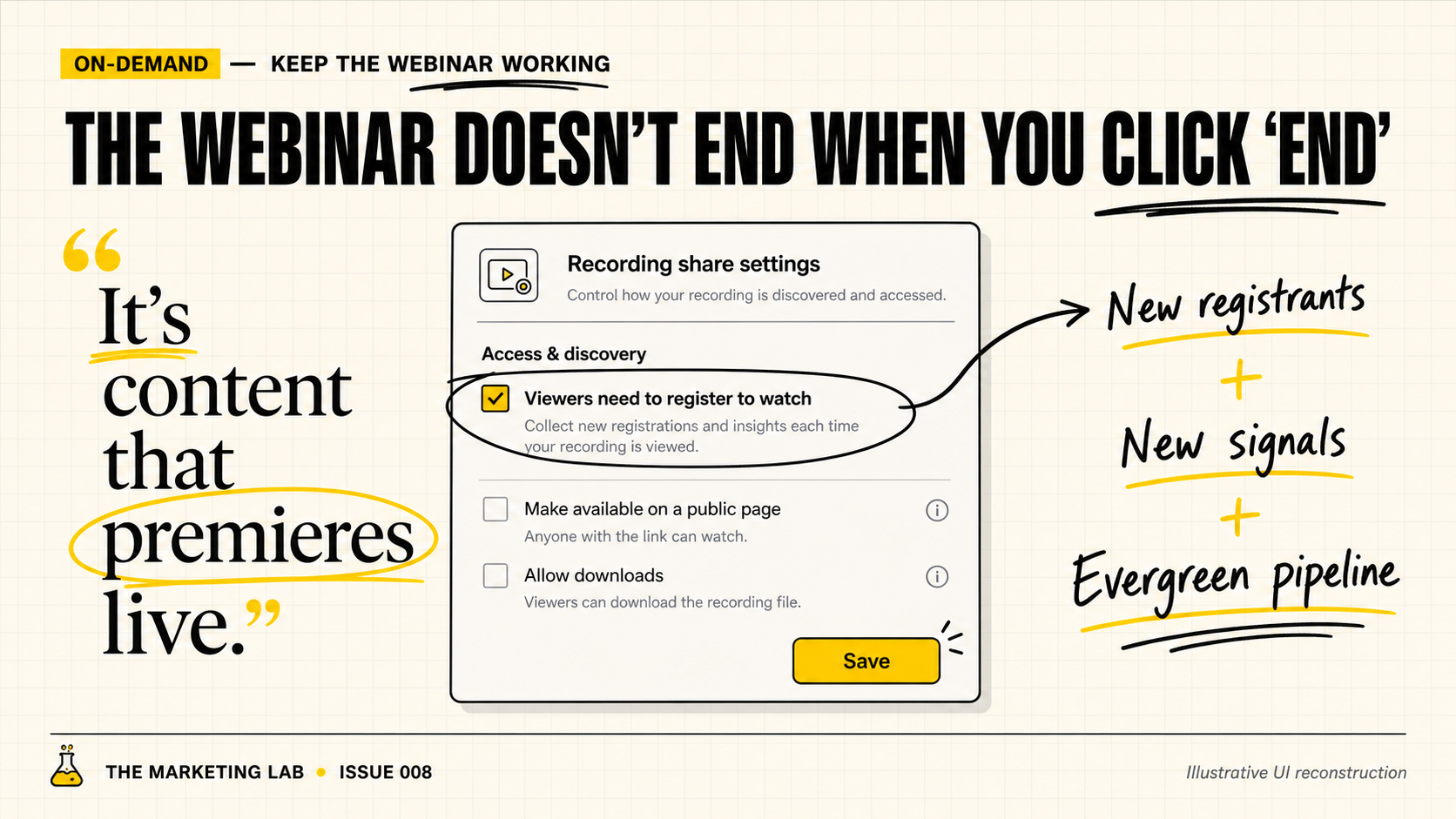
7. Do not let the webinar die when you click “End”
Make the cloud recording available on demand, with registration required to access it.
Now the webinar you spent weeks producing is not finished. It becomes an evergreen asset. You can keep promoting “Watch the webinar” for the next three months, collect new registrants, and capture new signals.
The mindset shift is simple:
Do not think of your webinar as an event that produces a recording.
Think of it as content that premieres live.
Then repurpose it: a full on-demand session, LinkedIn clips, a carousel, an article, short Q&A posts, a poll-results post and perhaps a follow-up webinar. One hour can have a six-week content tail.
8. Give every promotional channel its own registration link
One webinar URL everywhere tells you very little.
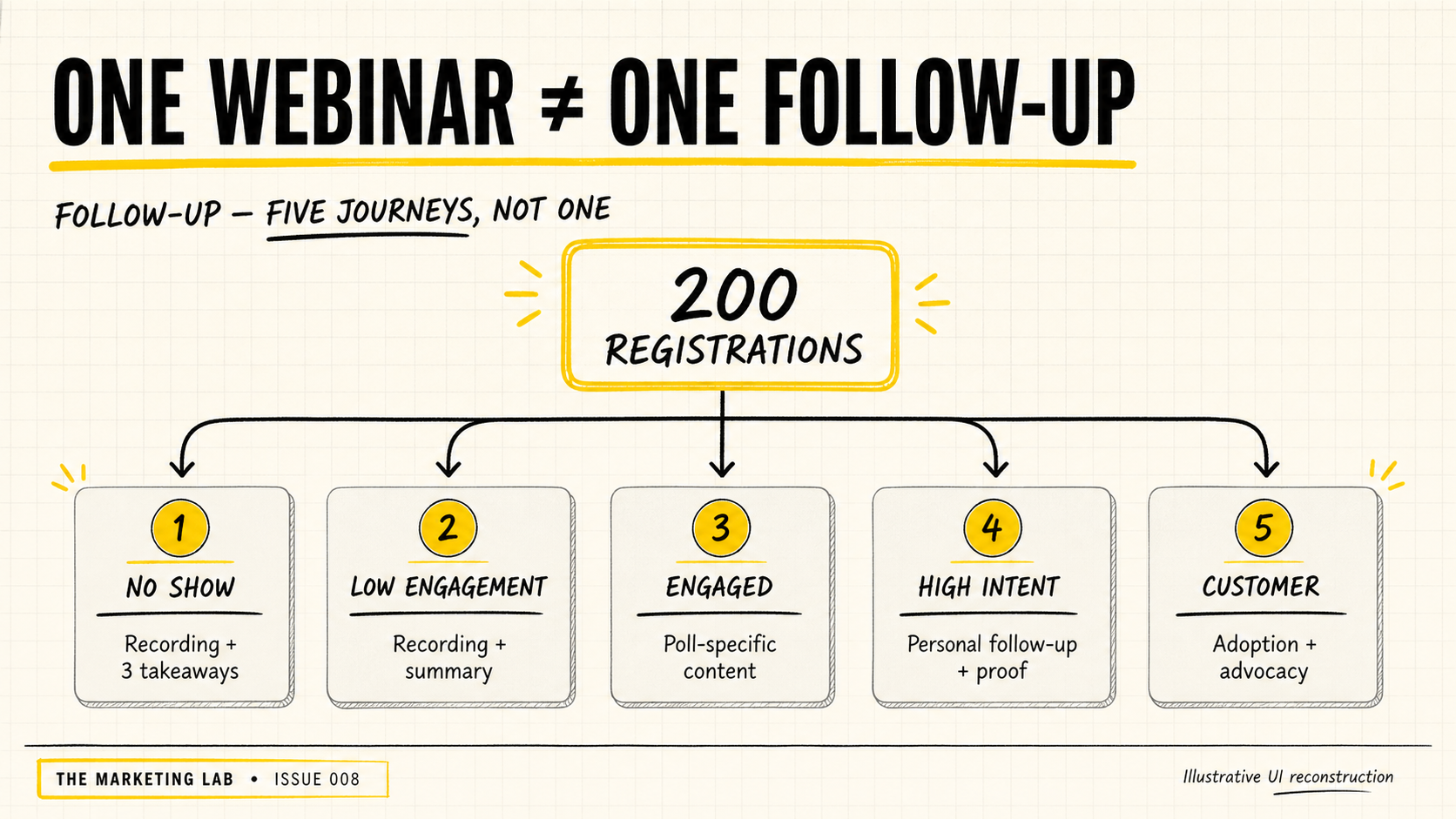
Instead create unique links for LinkedIn organic, employee advocacy, the email database, partners, paid LinkedIn and each speaker.
Then you can see what each source actually did:
| Source | Visits | Registrations | Visit → registration |
|---|---|---|---|
| Company LinkedIn | 800 | 72 | 9% |
| 450 | 126 | 28% | |
| Speaker | 180 | 71 | 39% |
| Partner | 220 | 53 | 24% |
| Paid LinkedIn | 1,400 | 42 | 3% |
Suddenly, “the speaker only got 180 clicks” does not look disappointing. They generated 71 registrations. Meanwhile, paid LinkedIn produced plenty of traffic and a comparatively weak conversion rate.
That is how the next webinar gets smarter.
The bigger Marketing Lab idea
This is not really an article about eight ways to improve a Zoom webinar.
It is about the webinar after the webinar.
Before the session, registration source and registration questions tell you who someone is and what they expect. During it, attendance, poll answers, Q&A and resource clicks tell you what they care about and how engaged they were. Afterwards, that becomes a more useful attendee profile—and a better follow-up.
We obsess over getting 200 people to register for a webinar. Then 80 show up. Those 80 spend an hour telling us what they care about. They answer our polls. They ask questions. They click resources. They stay for 57 minutes.
Then the webinar ends and Marketing sends all 200 people:
Thanks for attending. Here’s the recording.
What a waste.