
There’s an old saying in the startup world: ask for money, you get advice. Ask for advice, you get money.
I think the same applies to B2B sales.
When I first started as a BDR for an HR tech company, I did what I thought I was supposed to do. Find the right person. Connect. Pitch. “Hi, we do X. Keen for a demo?”
BANG. Nothing. Try the next person. BANG. Nothing again.
I can’t remember what made me change tack, but eventually I tried something different. I told people I’d just joined the company and was still getting my head around the product. They knew HR better than I did. Could I get their advice on whether they thought something like this would actually work?
Suddenly, around 6 out of 10 said yes.
Same product. Same target audience. Same BDR. The only thing I changed was the reason I gave them to speak to me.
Maybe there was a bit of ego involved. People like being asked for their advice. They like knowing someone values their experience. But the important bit was this: I stopped asking them to become a prospect and started asking them to become an expert. And I got the meeting anyway.
Getting the meeting is even harder today
That was years ago. Today, I think the direct route is even harder. People don’t answer calls from numbers they don’t recognise because half of them seem to be scams. Spam rules have become stricter. Inboxes are overflowing. And everyone has discovered LinkedIn automation, so even the supposedly “personal” channel doesn’t feel particularly personal anymore.
I recently spoke with a CHRO who asked me to guess how many pitches he gets from HR vendors every month. 20? 30? 50?
He last counted 81. Eighty-one emails and DMs every month from people who essentially want one of three things:
- Help me hit my sales quota.
- Let me sell you something.
- Please take my demo.
If you were in his shoes, what would you do? I know what I’d do. Ignore almost everything.
This is the problem with B2B marketing today. We’ve spent years trying to make the funnel shorter. Remove friction. Automate outreach. Book meetings directly into calendars. Go straight to the bottom of the funnel.
Except buyers have learnt exactly what we’re doing. The shortest route is now the route they’re most determined to avoid. So maybe we need to go the long way around.
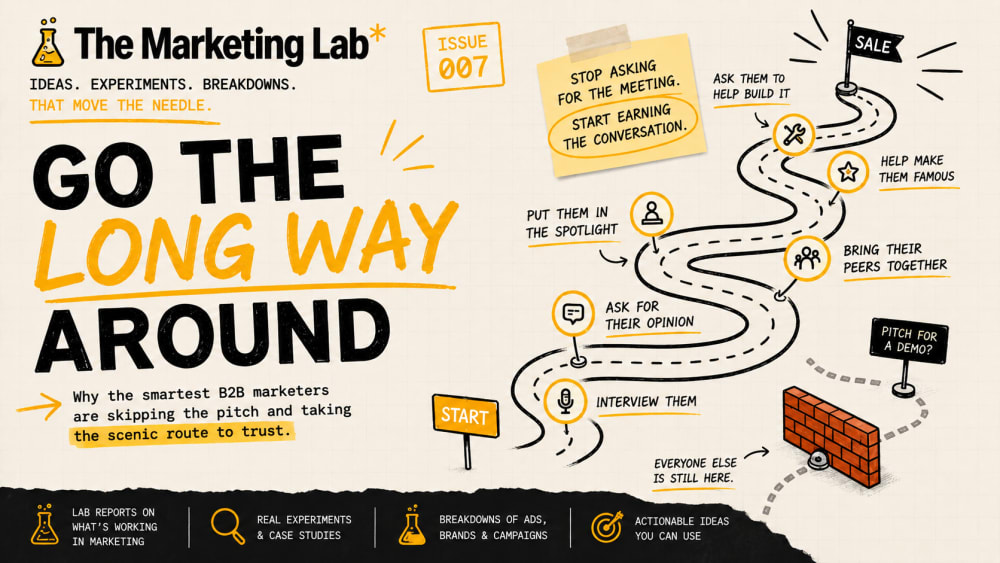
Detour #1: Put them in the spotlight
One example I’m currently working on is a campaign for my client, aTalent. Instead of approaching senior HR and workforce leaders to talk about aTalent, we’re running the Trailblazers campaign. The premise is simple. Find people doing interesting work in workforce transformation and recognise them for it.
Think about how different those two approaches feel. “Can I tell you about our HR tech?” versus “We think the work you’re doing deserves recognition.” One is asking for something. The other is giving something. And once someone participates, you’ve created a perfectly legitimate reason to know each other.
There’s a caveat. The spotlight has to be real. If your “Top 50 Industry Leaders” award exists purely because you scraped 50 prospects from Salesforce, people will see through it. Recognition only works when the recognition itself has value.
Detour #2: Interview them
I’ve written before about why I think more B2B companies should have podcasts. This is one of the reasons.
I’m currently a co-host of Rolling Stories, where we invite CHROs to share their experiences, lessons and perspectives. Think about the strange economics of this. You might struggle to get 15 minutes from a CHRO to show them your software. Ask the same person to appear on your podcast and share what they’ve learnt over their career? They may happily spend an hour with you.
Same person. Same company approaching them. Completely different value exchange.
aTalent is now also starting its own podcast on my recommendation. The access is key, especially if you record in person. You’re sitting across from someone you actually want to know, having a proper conversation without trying to squeeze a demo into it.
Detour #3: Ask for their opinion
My BDR experience was probably the simplest version of this. People like giving advice. So give them something worth having an opinion about.
Instead of “Can I show you our new product?” try “We’re building something for HR leaders and I’d love your brutally honest take on it.”
Or conduct proper industry research. Interview 30 CHROs about how they’re using AI. Ask 50 talent leaders what skills they think will disappear over the next five years. Ask HR teams where their tech stack is failing them. Then publish the findings.
Yes, you get content. But you’ve also created a reason to speak with 30 or 50 people in your ICP. That may be considerably more valuable than the report.
Detour #4: Ask them to teach
Don’t invite them to your webinar. Invite them to speak at it. Don’t ask them to attend your event. Put them on stage.
Look at Workday Elevate Singapore. Workday could spend the whole event telling HR leaders how great Workday is. Instead, its programme includes customer conversations featuring leaders from companies such as tiket.com and PropertyGuru Group sharing their own experiences.
That’s a very different proposition for both the speaker and the audience. The speaker gets visibility and authority. The audience gets to hear from a peer rather than another vendor. And Workday? Workday owns the room.
You are changing someone’s role from prospect to expert. That’s a much easier invitation to accept.
Detour #5: Bring their peers together
This one gets even more interesting. There are companies whose entire business model proves the point.
FIP Executive Events organises invitation-only dinners and roundtables for CHROs, CPOs and senior People leaders, hosted in partnership with HR tech companies. Typically just 12 to 16 people. And one of the promises? No sales pitches.
Think about how backwards that sounds. An HR tech vendor ultimately wants to sell to CHROs. So it spends money getting a group of CHROs into a room, and then promises not to sell to them. But that’s precisely why they come. FIP says more than 1,500 HR leaders have participated in its events.
You don’t need to create a 500-person conference to replicate the idea. Invite eight CHROs to dinner. Bring ten talent leaders together for a closed-door discussion. Pick one problem they all care about. And please don’t ruin it by sneaking a 30-minute product presentation into the middle. If the gathering is genuinely useful, being the person who brought everyone together is enough.
Detour #6: Help make them famous
Companies spend enormous amounts of time building their own executives’ personal brands. There’s another option. Build your customers’ and prospects’ brands.
Interview them. Profile their work. Turn their ideas into videos. Feature them in articles. Put them on stage. Help distribute their thinking.
If I can help a CHRO look smart in front of thousands of HR professionals, I’ve created value before they’ve bought a single thing from me. Compare that with “Just bumping this to the top of your inbox.” I know which one I’d respond to.
Detour #7: Ask them to help build it
Finally, stop assuming the only relationship someone can have with your product is buyer or non-buyer. They can also help shape it.
HR tech company Leapsome created a Customer Advisory Board of People and HR leaders to exchange experiences and influence where the product goes next. Recruitment tech company engin goes even further with its Design Partner Program. Its proposition isn’t “buy our recruitment technology.” It’s effectively “help us shape the future of recruitment intelligence.” Selected partners get early access and work directly with the product team.
Again, you’ve changed the relationship. You’re not asking someone to buy your roadmap. You’re asking them to help write it. Apart from getting genuinely useful feedback, people become invested in things they’ve helped shape. And once again, you’ve earned the conversation without asking for a sales meeting.
The long way around
None of these is a particularly clever hack. They’re all versions of the same idea I accidentally discovered as a BDR years ago. Give people a better reason to talk to you.
The old route looked like this: Vendor, pitch, meeting, sale.
The new route might look more like: Vendor, spotlight or podcast or research or community or advice, relationship, trust, commercial conversation.
Yes, it’s longer. It’s harder to put into a neat attribution dashboard. And your CFO might ask why you’re spending money interviewing people who haven’t bought anything. But consider the alternative. Your SDR can become pitch number 82 in someone’s inbox.
Lab Notes
We’ve spent years optimising B2B marketing to get to the sale faster. Maybe we’ve optimised it too far. Because buyers know exactly what’s waiting for them at the end of that “quick 15-minute chat.”
So don’t always ask for the meeting. Ask for their advice. Ask for their story. Ask for their opinion. Ask them to teach. Ask them to contribute. Ask them to help you build something.
You still want the meeting. You’ve just stopped asking for it.
Sometimes the fastest route to a B2B sale is the long way around.