
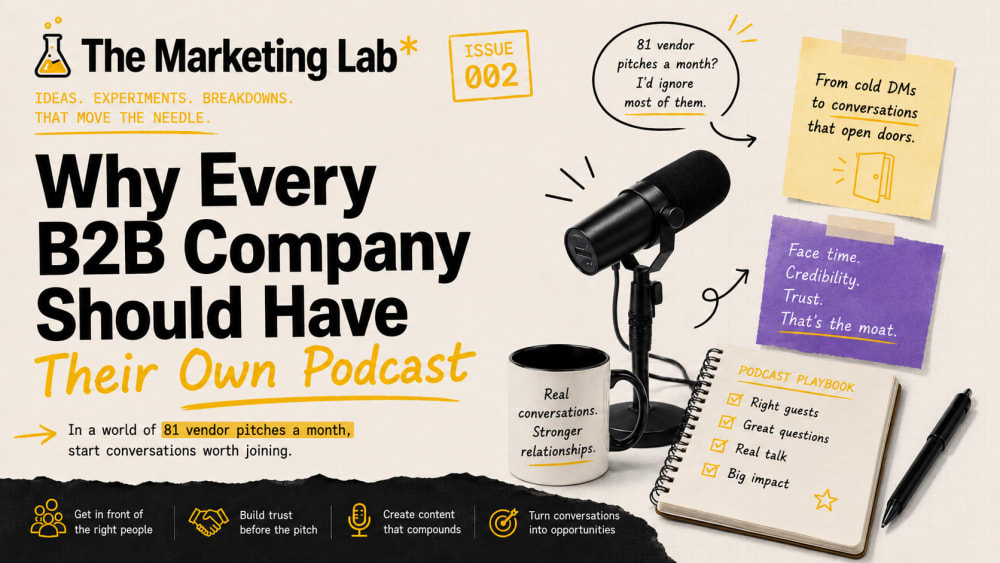
Most B2B companies are still trying to win attention in the worst possible way: cold emails, LinkedIn DMs, “quick 15-min demo?” requests.
But here’s what’s actually happening on the other side.
I spoke to a CHRO recently who told me he gets 81 vendor pitches a month. Eighty-one.
Emails, messages, outreach sequences, all saying some version of:
- “We can help you hit your goals”
- “Let me show you a quick demo”
- “Can I get 15 minutes of your time?”
At that point, it’s not even about your product anymore. It’s just noise. If you were in his shoes, you’d do the same thing: ignore most of it.
A moment that made this click for me
One of my client’s earliest enterprise customers didn’t come from outbound. It came through a podcast. Not even their own.
I was co-hosting a Channel NewsAsia podcast, and we had a CHRO on as a guest. After the recording, I casually asked her, “Have you heard of my client’s company?”
She had. She’d already been following them.
But that conversation changed something. It made it easier for her to bring them internally. Soon after, it helped accelerate conversations with almost the entire HR leadership team. That account became one of the client’s key customers.
I’ve seen this pattern repeat
I’m currently co-hosting another podcast, Rolling Stories, where we bring CHROs in to talk about their real experiences: what’s working, what’s broken, what they’ve learned the hard way.
I don’t always know if those conversations turn directly into deals. But I do know this: getting meaningful face time with senior decision-makers is getting harder every year. Not awareness, not leads. Just pure access.
Why podcasts work differently
A podcast flips the dynamic.
Outbound says, “Let me sell you something.” A podcast says, “I’d like to hear your perspective.”
That small shift changes everything. People open up more. They stay longer. They drop the polished answers. And they don’t feel like they’re being sold to.
The uncomfortable reality about outbound
When I asked that CHRO what he does with all those 81 vendor messages, he didn’t hesitate. He ignores them. Every single one.
I don’t blame him. I would do the same, because after the third one they all sound the same:
- “We help companies like yours…”
- “We’d love to show you…”
- “Quick demo?”
When everything looks the same, nothing stands out. Outbound stops being a channel. It becomes background noise.
What podcasts actually do
A podcast isn’t a lead generation machine. It’s a relationship shortcut. It gives you something outbound can’t: a real conversation in a context where no one is selling.
And something else happens after that. The guest starts associating you with that experience. And that carries further than most marketers expect.
Does it convert?
Not directly. And that’s where people misunderstand it. Podcasts don’t replace demand gen. They change what happens before demand gen even starts.
What you get instead: warmer conversations, faster internal buy-in, easier follow-ups, higher trust at first meeting. In B2B, that’s often what actually moves deals forward.
What to actually do with this
If you’re a B2B company thinking about podcasts, don’t overcomplicate it. Start simple, but start intentionally.
1. Don’t optimise for scale, optimise for access. This is not a “grow an audience” play first. It’s a “get in the room with the right people” play. Even one good guest per week, or two strong guests per month, compounds faster than most outbound funnels.
2. Make it physical, not just digital. If you’re selling enterprise, the real value isn’t the upload to Spotify. It’s the face time. The conversation before and after the recording is where trust actually gets built. This is why I’d strongly lean into in-person podcast setups. Places like Poddster and LFG let you walk in, sit down, and record a full episode without building your own studio. At a base level you’re looking at ~$200+ per session, or closer to ~$400+ per episode with basic post-production. For enterprise sales, that’s less than spare change. One meeting with the right CHRO or VP-level stakeholder can justify months of that spend.
3. Distribution is free, don’t overthink it. Once the episode exists, YouTube, Spotify, LinkedIn clips and short-form distribution are all free. You are no longer paying to reach people. You are paying to create the moment. Everything after that is leverage.
4. But the conversation matters more than the setup. This is where most podcasts quietly fail. We once had a guest who showed up basically reading from a pre-written script. It had clearly been reviewed, approved, polished, probably even “safe-checked” internally. The problem? It sounded like a brochure. No rhythm, no thinking out loud, no real opinions. Just polished corporate language delivered in human form.
5. You need to be able to actually host. Good podcasting is not about asking pre-written questions. It’s about listening properly, reacting in real time, pulling threads that weren’t in your prep, and letting the conversation go slightly off-script when it matters. That’s what separates an average host from someone people actually want to speak to again. And that takes practice.
6. Don’t be afraid to get help early. If you’re serious about doing this, consider bringing in someone who’s done it before, even for the first few episodes. Not to run it forever, but to set tone, sharpen your questioning, avoid early mistakes and accelerate the learning curve. The first 5 to 10 episodes are where most podcasts either become real or quietly die.
Lab Notes
Podcasts work because they do something most marketing can’t anymore: they create permission. Permission to speak. Permission to listen. Permission to be remembered.
And in a world where most buyers are already ignoring 80+ pitches a month, that permission is becoming the real advantage.