
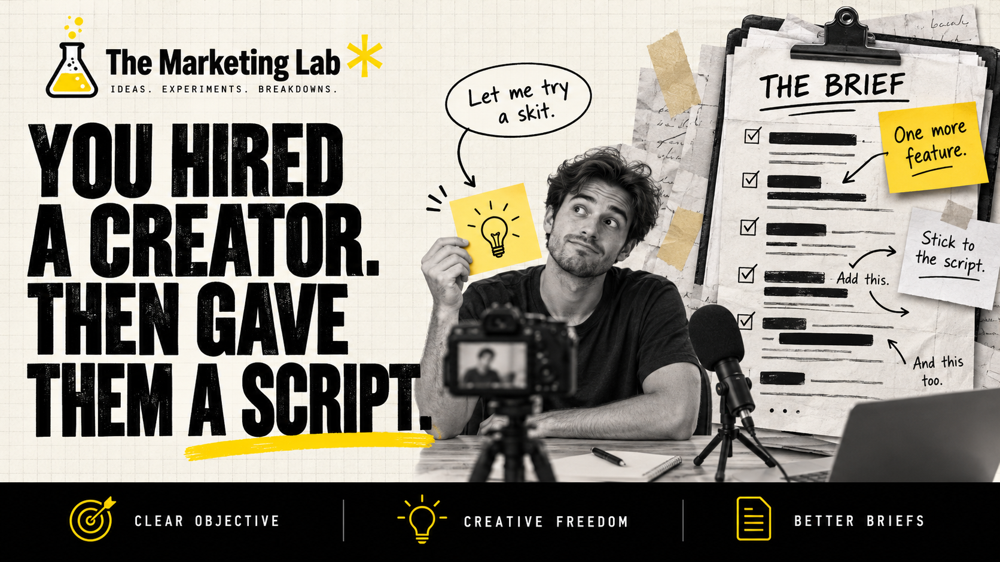
I’ve sat on both sides of a creator brief.
As a marketer, I understand the urge to be specific. There’s a product to explain, a message to land and someone internally asking whether we can mention just one more feature.
As a creator, I know what happens when all those requests arrive in the same document.
You spend so much time fitting everything in that you stop asking whether anyone would want to watch it.
Two campaigns brought this home for me.
One software campaign gave me a fairly defined execution: demonstrate a real workflow, show the steps and explain the result.
I made the video. It underperformed.
Another campaign, for Miracly, gave me room to decide how to make the product interesting to my audience.
I went with a skit.
Both videos went out on my LinkedIn profile. Neither received paid support.
The Miracly video reached almost twice as many people. Its average watch time was 29 seconds, compared with 12 seconds for the other campaign.
Accounting for their different lengths, viewers watched roughly 26% of the Miracly video on average, versus 9% of the other one.
That isn’t a completion rate. And two campaigns don’t make a controlled experiment. The products, timing, hooks and lengths differed.
But the difference in attention was enough to make me think about how we brief creators.
How much of their judgement are we actually letting them use?
Choosing the example isn’t the same as choosing the approach
A brief can offer ten possible use cases and still leave very little creative freedom.
If every option must become a talking-head introduction followed by a screen recording and a product explanation, the format has already been decided.
The creator gets to choose which example goes into it.
A walkthrough may be exactly what an audience needs. There’s nothing inherently wrong with the format.
But it should be a choice made with the creator, based on what their audience responds to.
I’ve been doing more skits because I enjoy the format. It gives me room to build a recognisable situation, play with the tension and introduce a product through something happening.
With Miracly, I could use that approach.
The brief still had requirements. I needed to explain the product accurately, include the necessary campaign details and submit the content for approval.
It also explicitly invited me to adapt the angle to my usual style and audience.
That gave me something useful to work with: a clear objective and room to find the story.
A creator brings more than a camera and a following
When you hire a creator, you’re paying for production and access to an audience.
You’re also paying for judgement developed through publishing.
Which situations do people recognise? Which openings lose them? What sounds natural coming from this particular person?
That knowledge should influence the content before the camera comes out.
Otherwise, you can end up paying for a creator and using them as a presenter.
A perfectly competent presenter, reading a perfectly approved message, to an audience that has already scrolled away.
Write a brief that leaves useful decisions open
For your next creator campaign, try organising the brief around five questions.
1. Who needs to care?
Describe the person and their problem.
“HR decision-makers” gives the creator a category.
“A payroll manager who spends the last working day of every month chasing missing information” gives them a situation.
The more recognisable the situation, the more there is to build a story around.
2. What should they understand afterwards?
Choose one main takeaway.
If the audience remembers one useful thing about the product, what should it be?
This is a decision the brand needs to make. Handing over six equally important messages leaves the creator to finish a prioritisation discussion you haven’t resolved internally.
3. What must be factually correct?
Explain what the product does, which claims are supported and which limitations matter.
Give the creator access to the product where possible. Let them discover something they can explain from experience.
Accuracy needs clear direction. A creator shouldn’t have to guess whether a feature works the way the marketing slide suggests.
4. What is genuinely non-negotiable?
List required disclosures, factual restrictions, deliverables and approval dates clearly.
Separate these from suggestions.
If you offer three possible hooks, make it clear that the creator can propose a fourth.
Otherwise, “some ideas to get you started” can easily become a checklist everyone expects to see in the final video.
5. What would the creator propose?
Ask for a hook, a format and a short explanation of why it fits their audience.
Do this before filming.
A few sentences or a rough storyboard can reveal a mismatch while it’s still cheap to fix.
The question I’d put at the end of every creator brief:
“How would you make this interesting to your audience?”
Then leave enough room for the answer to change your plan.
Creative freedom needs to survive the revisions
A concept gets approved.
Then someone asks for an earlier product mention. Someone else adds two features. Another person removes the joke because it feels risky.
By the final edit, the creator is performing a concept nobody originally proposed.
Agree on the core idea before production. During review, explain the problem you need solved.
“The viewer may misunderstand this feature” gives the creator something to fix.
“Say this sentence exactly and move the logo to the opening shot” starts directing the execution again.
Sometimes precise wording is necessary. Use it where accuracy requires it, and give the creator room to solve the rest.
My part in the weaker campaign
I accepted the brief and made the video.
Looking back, I should have pushed harder on whether the approach suited my audience.
Agreeing to an execution and hoping I can make it work is still a decision. I don’t get to blame a document for every weak result.
Creators need to bring their judgement into the conversation early enough for it to help. Brands need to make that conversation possible.
For your next campaign, send the objective, product facts and boundaries first. Ask the creator to return with an approach before you write the shot list.
Give their judgement a chance to earn its fee.