
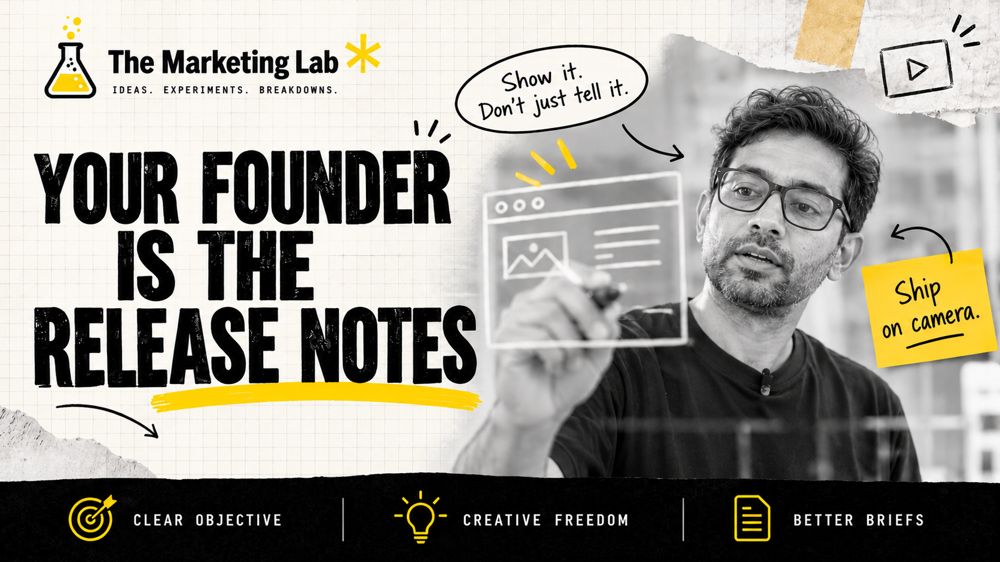
I stopped scrolling on a guy drawing on glass.
He’s Farza Majeed, founder of HeyClicky. His post was about 60 words long. The video showed him sketching app windows in the air while the caption explained what his team had just shipped. I watched it twice, then went to find out what HeyClicky was.
That’s the entire job of a feature announcement. Most B2B companies, with a full comms team and an approval chain, don’t manage it.
So for the last issue of the year, we’re looking at founders and builders who announce features on camera: why it works, who’s doing it well, and what a bigger company can realistically copy.
1. The post that stopped me
Here’s the whole thing:
Today we’re shipping spatial context.
This lets you draw directly on your screen and pass it as context to the model.
AI can easily analyze a screenshot. But, it has no idea where exactly you want it to look. Now you can just draw directly on your screen and show it.
No more screenshotting + annotating for ChatGPT or Claude!
Very intuitive, very useful. Enjoy.
Five things are doing the work:
- The first line is the announcement. No “thrilled to share”, no origin story, no rocket emoji.
- The problem takes one sentence. AI can read a screenshot but doesn’t know where you want it to look. Anyone who’s used ChatGPT for a week has felt that.
- It names the chore it kills. “No more screenshotting + annotating.” That’s a specific, annoying thing the reader does every week, using tools they already pay for.
- There’s no call to action. No “link in comments”, no “DM me for access”. The post is confident enough to just stop.
- The video acts out the feature. He draws on glass in a real room. Captions on for people scrolling on mute, a clip-on mic in view. It looks like it was filmed that afternoon.
How to copy it: one feature per post. Show the product doing the thing within the first few seconds. Post from a person’s profile, and keep the company page for reposting.
2. How startups do it
Farza isn’t the first, and he won’t be the last. Three more cases, each showing a different version of the same move.
Dropbox: the original
In 2008, Drew Houston didn’t have a product stable enough to demo live, so he recorded a short screencast instead. In his own words, “our beta waiting list went from 5,000 people to 75,000 people literally overnight.”
The detail most people forget: the video was full of in-jokes aimed at the exact community he posted it to. Houston said they “put in about a dozen Easter eggs that were tailored for the Digg audience.”
How to copy it: make the video for one specific room. A demo written for “everyone” lands with nobody.
Manus: the office corner
Manus, now run by Singapore-based Butterfly Effect, launched in March 2025 with a four-minute demo presented by co-founder and chief scientist Yichao “Peak” Ji. MIT Technology Review described it as no elaborate production, directed by a co-founder and filmed in a corner of the team’s office in Beijing. It picked up over 200,000 views on X shortly after release.
The video showed the agent doing three real tasks: screening resumes, picking properties and analysing stocks. No animated explainer, no stock footage.
How to copy it: put your most technical person in front of the camera and have them show real tasks end to end. Viewers forgive bad lighting. They don’t forgive a demo that cuts away right before the hard part.
The Browser Company: the weekly habit
The Browser Company (makers of Arc, and now Dia) used YouTube for regular product updates, most of them opening with co-founder and CEO Josh Miller talking into his webcam in what looked like his bedroom. One write-up noted the lighting was a bit off and the framing wasn’t great, and that it worked anyway.
Miller also used the format for bad news. One video was titled “We Might Not Make It”.
How to copy it: treat video as a habit, every time something ships. One big launch film a year doesn’t build the same trust as 50 small updates.
3. “OK, but we’re not a startup”
Fair. HeyClicky is a young startup with a founder who loves the camera. If you’re at a 2,000-person company with a legal team, here are 4 ways the same idea works at scale, ranked roughly from hardest to copy to easiest.
Model 1: Buy the voice (Dollar Shave Club)
In March 2012, Michael Dubin uploaded a one-take video of himself walking through a warehouse explaining why razors were overpriced. It cost about $4,500. It brought in 12,000 orders in 48 hours.
Unilever later bought the company for $1 billion. That’s roughly 222,000 times the video budget, paid by one of the world’s biggest marketers for a voice it couldn’t produce in-house.
Model 2: Lose the voice (The Browser Company, again)
The flip side of Model 1. After The Browser Company became part of Atlassian, Miller suggested they may move away from the direct-to-camera announcement videos they used to make.
Put Dollar Shave Club and The Browser Company side by side and the pattern is uncomfortable. Big companies buy founder voices, then often can’t keep them alive inside the org chart.
Model 3: Let the builder post it (Supabase)
This is the realistic model for most enterprises. The PM or engineer who built the feature records a short demo on their own profile, and the company amplifies it.
Supabase built a whole ritual around this. They ship for a few months, then announce one thing every day for a week, which they call Launch Week. Co-founder Paul Copplestone has said the real value now is internal: it gives engineers a rhythm to ship and practice talking about what they built.
See every Supabase Launch Week
LinkedIn has made the amplification part easier. Since 2024, Thought Leader Ads let companies sponsor posts from any LinkedIn member, employees included. LinkedIn’s own launch guidance claims employee shares can reach up to 12 times a company page’s audience (it’s LinkedIn’s number, and LinkedIn sells those ads, so take it with some salt).
The usual blocker isn’t budget. It’s policy. Plenty of companies still discourage or forbid employees from posting about company topics, then wonder why the company page gets 20 likes.
Model 4: Rent the voice (creators)
If nobody inside will go on camera, pay someone outside who already has the audience’s trust. B2B creator budgets grew through 2026, and my bet is they keep growing in 2027, because buyers trust someone who isn’t on your payroll more than they trust your company page. The brief matters more than the fee: give the creator the product and the problem, then let them show it in their own words.
4. The rewrite
Here’s the kind of announcement most B2B companies still post. The company is made up. The sentences, sadly, are not.
We are thrilled to announce the launch of Paylytix CPF Intelligence, our next-generation AI-powered compliance solution designed to empower HR teams to seamlessly streamline payroll accuracy and unlock unprecedented efficiency across the organisation. #Innovation #HRTech #FutureOfWork
And here it is in Farza’s format:
Today we’re shipping CPF check.
It flags contribution errors before you run payroll.
Right now most errors get caught after the money’s gone out, usually by an employee squinting at their payslip.
No more backdated adjustments and awkward emails to the whole team.
Small feature. Saves a bad Monday.
Attach 30 seconds of the PM running a test payroll and the error popping up. Done.
5. The Singapore problem
I went looking for a homegrown Singapore B2B founder who regularly announces features like this. I couldn’t find one.
The irony is that the format has Singapore roots. Supabase’s founders met at Entrepreneur First in Singapore in 2020, and the company still has an office here (Singapore’s GIC was reportedly in talks to lead a round at around a $10 billion valuation). Manus is now headquartered here.
The format started here. It just didn’t stay here.
Meanwhile, most local B2B feature updates still go out the way they did in 2015: a press release, posted from the company page, liked by 20 colleagues.
That’s the opening. When nobody in your market does this yet, the first company that makes it a habit gets noticed by default.
6. The template
Today we're shipping [feature].
It lets you [one action].
[The problem, in one sentence].
No more [specific chore your customer hates].
[Short sign-off].

+ 30 to 60 seconds of a human showing it, captions on
+ Posted from that human's profile, reposted by the company page
7. The diagnostic
Run these before your next feature announcement.
- Who in your company is allowed to say “we shipped this” on camera? If the answer is “comms, after legal approves the script”, that’s your real bottleneck. It isn’t the video.
- Can you describe the feature in one sentence without the words “AI-powered” or “solution”? If not, the feature isn’t clear yet, and no video will fix that.
- What chore does it remove? Write it the way a customer would complain about it over lunch.
- How many updates last quarter came from a person instead of the company page? Zero is a common answer. It’s also the problem.
- If someone filmed it on a phone this afternoon, what would stop you posting it tomorrow? List the blockers. Then ask which ones actually protect the company and which ones only protect the process.
That’s the last Marketing Lab of 2026. I’m taking a break, and I’ll see you in the new year.
Somewhere in Singapore, somebody is going to be first to draw on the glass. It might as well be the person who built the thing.
Sources
- Farza Majeed, LinkedIn post announcing HeyClicky spatial context
- How DropBox Started As A Minimal Viable Product (TechCrunch)
- How Yichao “Peak” Ji became a global AI app hitmaker (MIT Technology Review)
- New Chinese AI agent Manus sparks industry buzz (VnExpress)
- Manus launch coverage (Yicai Global)
- Lights, Camera, Arc-tion (Failory)
- The Browser Company and Radical Transparency
- Josh Miller on Dia (PiunikaWeb)
- How a $4,500 video changed DTC marketing (Creative Discipline)
- Dollar Shave Club launch video (eChai)
- Paul Copplestone: scaling to 5M developers with no meetings (Evil Martians)
- FA Company Spotlight: Supabase
- LinkedIn’s three-phase B2B launch framework (PPC Land)
- LinkedIn guidance on B2B product launches (Social Media Today via Pulse)
- B2B influencer marketing in 2026 (Net Influencer)