
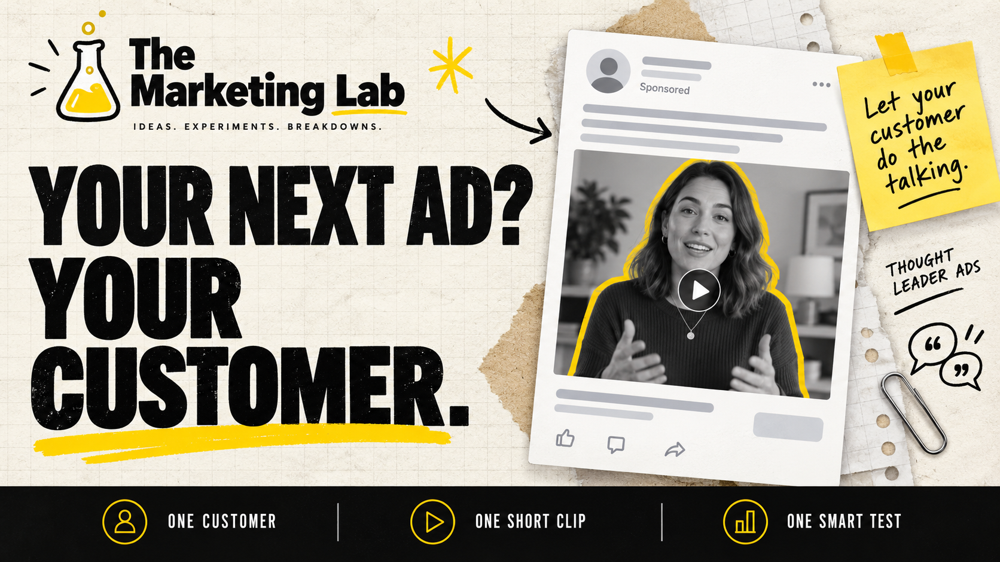
You finally get a customer to agree to a video testimonial.
You organise the interview. Edit the footage. Add subtitles. Survive three rounds of approvals.
Then you upload it to your company page, where it receives seven likes.
Four from colleagues. One from the agency. Two remain under investigation.
There’s another way to distribute that video: have the customer publish it, then pay to put their post in front of your buyers.
LinkedIn calls the format Thought Leader Ads. You can sponsor posts from customers as well as employees, industry experts and creators. The post remains attached to its author, with paid distribution behind it.
The customer application caught my attention because there’s a useful case study behind it.
Same video. Different results.
Australian legal software company Smokeball produced a three-minute video featuring a customer, Empire Legal.
They cut it into 30-second clips, invited the customers to publish them on LinkedIn, and promoted those posts as Thought Leader Ads.
Compared with conventional video ads featuring the same videos, LinkedIn reports:
- 2× the video view rate
- 8.7× the video completion rate
- 50% lower cost per view
- 186% increase in return on ad spend
Smokeball also turned the footage into blogs, written case studies and sales materials. One interview did quite a bit of work.
Read Smokeball’s customer video campaign case study.
The comparison matters. This wasn’t simply a customer video outperforming a product brochure. The same footage performed differently when served through a customer’s post.
A caveat before we all rewrite our media plans: this is a LinkedIn-published customer success story. It doesn’t disclose enough about budgets, audiences or experimental controls to promise the same uplift elsewhere.
It does give us a sensible experiment to try.
Start with one customer and one problem
Choose someone whose working day resembles your buyer’s.
For an HR tech company, that might be a payroll manager who used to spend Friday afternoons chasing corrections. Their experience gives another payroll manager something concrete to recognise.
You need a story with a clear change. A large logo and “great service, highly recommended” won’t give you much to work with.
Three interview questions can help:
- What did this task look like before?
- What do you do differently now?
- Can you give me a recent example?
That last question is where the useful detail often lives.
For illustration, “training is much easier” could become:
“We used to message supervisors to find out who had completed training. Now I can check the dashboard and follow up with the people who still need help.”
A buyer can picture that.
Cut one clip that makes sense on its own
For your first test, aim for roughly 30 seconds, following Smokeball’s approach.
Keep one complete thought: the problem, what changed and why it helped. Add captions and enough context for someone who has never heard of your company.
Give the customer room to sound like themselves. If they would never say “seamless transformation” in conversation, it probably shouldn’t appear in their mouth now.
Have them publish the clip with their own explanation of the experience. Agree upfront on the footage, wording and paid promotion.
Put paid distribution behind the post
In LinkedIn Campaign Manager, create a compatible campaign, select the customer’s eligible post and request permission to promote it. The author must approve before you can use it as a Thought Leader Ad.
For this video experiment, Video Views is one available objective; LinkedIn also lists Brand Awareness and Engagement. Check the post’s eligibility before committing to production.
See LinkedIn’s Thought Leader Ads guide.
Target the buyers for whom the customer’s problem is relevant.
A payroll story should earn attention from people who deal with payroll. “Everyone in HR” may be stretching it.
Give it a fair comparison
Run the same clip as a conventional company-page video ad, with comparable audiences, budgets, timing and objectives.
Compare viewing costs and completion rates first. Then look for qualified website visits, enquiries and opportunities where you can track them.
Treat a small campaign as a directional test. Cheap views alone won’t tell you whether it helped sell anything.
This issue’s experiment
Find one customer who can describe one useful change. Capture it in one short clip. Test their post against your company’s version.
You may already have the footage sitting in a folder.
Somewhere between “Final” and “Final_FINAL_Approved_v6”.